Chandler Simpson: A throwback defying Modern Player Models
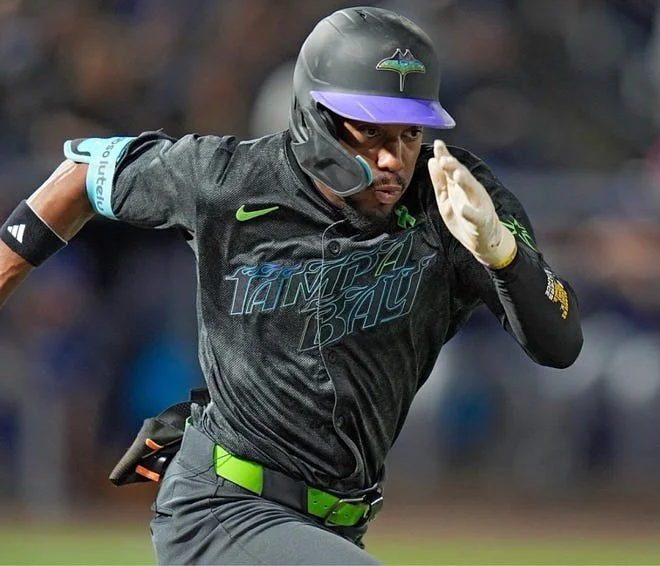

Chandler Simpson: A Throwback Defying Modern Player Models
Born and raised in Atlanta, Georgia, Chandler Lenard Simpson is what we call a true game-changer. The 25-year-old began his collegiate career at the University of Alabama at Birmingham before transferring to Georgia Tech. I don’t view him as a late bloomer but as a player whose skill set was likely undervalued by major Division I programs because they simply didn’t know what to make of him. In his junior year at Tech, his .433 batting average led all of NCAA Division I and earned him first-team All-ACC honors as well as NCAA All-American recognition. He didn’t exactly come out of nowhere as some have suggested, but had a track record of hitting and performance. Those performances, combined with his summer 2021 dominance in the Northwoods League (where he stole 55 bases in just 51 games), put him firmly on scout’s radars.
The Tampa Bay Rays, known for their sharp eye for undervalued talent, selected the outfielder in the Competitive Balance B round of the 2022 MLB Draft (70th overall). He signed for a $750,000 bonus, notably below the assigned slot value of approximately $953,000. A shrewd pick that aligns perfectly with the Rays’ development-first philosophy.

From College Standout to Professional Catalyst
Simpson’s path has been anything but linear. He made a position change, transitioning from middle infield in college to the outfield in professional baseball, where his long strides and elite speed could finally be fully utilized. By 2024 in the minors, he emerged as a legitimate nightmare for opposing defenses: batting .355 to claim minor league batting champion honors, he also stole 104 bases in 121 attempts, and had a remarkably low strikeout rate (just 43 Ks in 504 at-bats). He made his MLB debut in April 2025 and has since become a dynamic presence for the Rays, seamlessly blending elite contact hitting with game-altering speed.
Strengths and Weaknesses
Strengths:Simpson makes consistent contact thanks to his outstanding hand-eye coordination, and his elite speed disrupts opposing defenses. He puts the ball in play at an exceptional rate and leverages his legs to turn routine singles into extra bases or ground balls into hits. Defensively, he has shown positive improvement in the outfield, especially in 2026.
Weaknesses:Power remains the most obvious missing element in his game. With minimal hard contact and virtually no home run power, he relies on placement and speed rather than raw strength. With added muscle and the ability to drive the ball into the gaps, he could take his game to another level.
There’s also an element of impatience, his walk rate and pitch selection could use refinement. As a hitter, some strikes simply aren’t pitches you can drive hard, especially early in counts or when pitchers are ahead. Opposing pitchers challenge him in the zone because they don’t fear him taking the ball out of the park. If he can improve his walk rate to league average, he becomes a prototypical top-of-the-order threat rather than primarily an ideal ninth-hole weapon on championship teams.
He has a below-average arm that opponents can challenge, so he must always be aggressive on balls hit in front of him. Throwing mechanics need work. There have been inconsistencies in his defense. The late reads and routes have improved but remain areas of focus. He also still tends to drift on high fly balls, this happens when he tracks backwards.
Blazing Speed
Speed defines Simpson’s game. He has posted sprint speeds in the 97th – 99th percentile (consistently around 29.6 ft/sec), with several plays exceeding 30 ft/sec. His home-to-first times have been clocked as low as 3.69 seconds; his average of 3.95 puts him among baseball’s fastest players, if not the fastest. He has stolen bases in high volume throughout his career, including the 104 in a single minor-league season, with consistently strong success rates.
Scouting Tool Grades (20–80 Scale, Approximate)
- Hit: 60/70 (plus to well above average; elite contact skills)
- • Power: 20/30 (well below average; minimal raw or game power)
- • Run: 80/80 (elite, often jokingly described as 90+; truly game-changing and in its own category)
- • Field: 45/55 (fringe average to possible plus, factoring in gains in range, reads, and center field versatility)
- • Arm: 30/40 (below-average strength; accurate but lacking carry)
Traditional Statistics (Through Late May 2026)
Building on a solid 2025 rookie campaign, Simpson has continued to make an impact early in 2026 (approximately 48 games, ~189 AB):
- Batting Average: .291 (elite contact production)
- • Runs: 26 (fueled by on-base ability and speed)
- • Home Runs: 0 (power is simply not part of his profile)
- • RBIs: 12
- • Stolen Bases: 14 (with a strong success rate)
- • OPS: .667 (a weak slugging percentage of .344 keeps it grounded, but his on-base skills shine through)
- These numbers describe a high-average, high-steal threat who excels at getting on base and manufacturing runs. In close games, he is especially dangerous.
Advanced Metrics
- In-Zone Contact: Elite 95.6%; he squares up pitches effectively when swinging in the zone and rarely swings and misses. His in-zone swing rate is 86%, meaning he swings at nearly anything in the strike zone.
- • Chase Rate: A low-to-moderate 32% outside the zone – solid plate discipline for a contact-oriented hitter.
- • K Rate: Elite 9.8%, ranking among baseball’s best and perfectly aligning with his hit tool.
- • Hard-Hit Rate: A low 15.5%, with a zero barrel rate and ground-ball tendency – all reinforcing his low-power approach.
His wRC+ sits around 90, reflecting solid but not overwhelming offensive value once speed and contact are factored in. He gets on base; the rest is up to his teammates.
Defense: Arm, Range, and Hands
Primarily playing left and center field, Simpson has improved markedly as an outfielder. He possesses good range courtesy of his speed, solid hands, and improving routes, though below-average arm strength can limit throws to home.
Defensive Metrics (2026 improvements highlighted):
- Outs Above Average (OAA): +5 (tied for fourth-best among outfielders); a dramatic leap from below-average grades in his rookie year, now well above average.
- • Defensive Runs Saved (DRS): Positive contributions, trending above average with strong positional value in left field. Now +3 (after -9 last season).
- • UZR (Ultimate Zone Rating): Improved efficiency reflecting better range, now above average overall.
Agreement and Divergence Between Stats
Traditional statistics (high batting average, stolen bases, little power) and advanced metrics (elite contact/low strikeouts, low hard-hit rate) largely align, confirming Simpson as a premier speed-and-contact specialist who pressures defenses without relying on power. They diverge on defense: the eye test still notes lingering route and arm concerns, whereas 2026 advanced metrics show significant gains and positive defensive value.

Game Impact
Simpson impacts games in ways that often escape traditional box scores. He turns over lineups with well-placed singles and bunts, steals bases to reach scoring position, and forces pitchers, catchers, and fielders into hurried mistakes. Opposing managers must constantly prepare for steals, hit-and-runs, and bunt defenses whenever he steps to the plate. His speed compels infielders to play shallower, reducing their range and opening holes for teammates behind him in the lineup. In many respects, his presence creates more discomfort than raw power hitters do. He serves as the ultimate table-setter and chaos creator in a Rays lineup that prizes versatility and run manufacturing.
This profile also illustrates why OPS sometimes falls short as a complete measure of value. A .667 OPS signals a below-average hitter due to limited slugging, yet Simpson’s elite hit tool, contact ability, and speed generate winning contributions that many analytical models undervalue or cannot fully measure. Holes open up due to necessary defensive positioning shifts. Hitters behind him see more fastballs, because if he’s running on a breaking ball, it’s probably too late. It’s hard to quantify the psychological effect a base stealer has on the pitcher and catcher. He may not light up every leaderboard, but he is precisely the type of player every contending roster would love to have. If you’re looking for a reason this team is clicking, this may be it.

Floor, Ceiling, and Comps
Floor: A reliable fourth outfielder or platoon option with high on-base skills and speed – a more dynamic, defense-improved contact specialist who sticks thanks to his baserunning abilities.
Ceiling: An All-Star leadoff hitter who annually steals 50+ bases, bats .300+, and delivers plus defense in the outfield. Even a small power development would elevate him to perennial impact status.
Comps: Simpson evokes comparisons to both Dee Gordon, and Billy Hamiliton but will strike out less than either of those players, a true throwback leadoff type whose game revolves around putting the ball in play and terrorizing defenses with his legs. In today’s power-centric era, he stands out as a reminder that speed still kills.
For Rays fans, Chandler Simpson embodies Tampa Bay’s player-development system: transforming an overlooked tool into a thrilling, winning weapon on the diamond.
