The Kings of Rock

Kings of Rock : The Run-DMC Saga
The first “concert” I ever attended was in a dingy Dickinson High School gym in Wilmington, Delaware, in 1984. Somehow, this new rap group that I was listening to heavily had decided to perform close to where I lived, and it didn’t take much convincing to get my brother and a couple of friends to go. Who would have thought we were about to see these guys blow up?
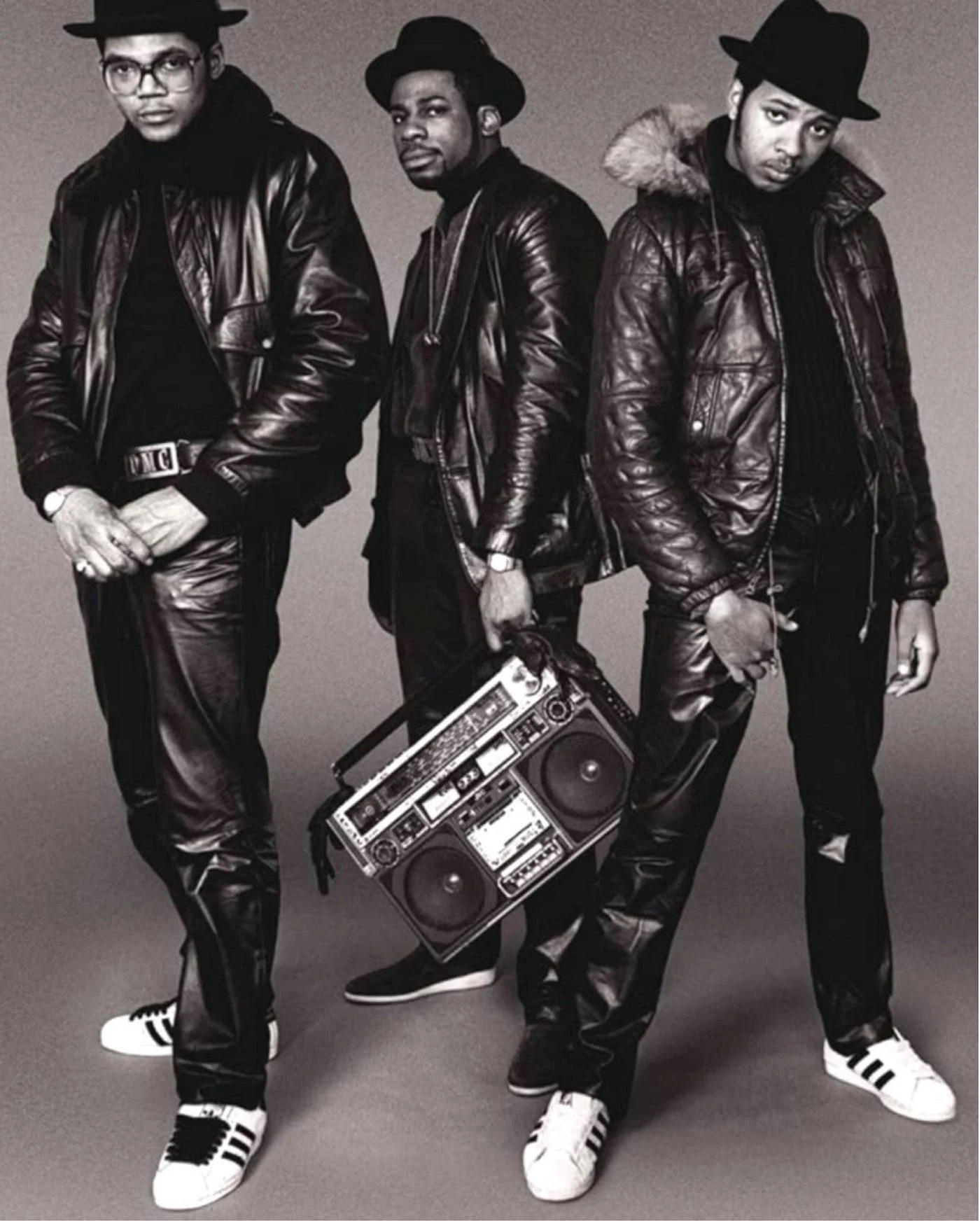
In the early 1980s, when hip-hop was seen as a passing city fad or the derisive “ghetto” sound, three young men from Hollis, Queens, strolled in wearing black leather jackets, fedoras, and unlaced Adidas sneakers like they owned the block — and promptly proved they did. Meet Run-DMC: the trio that didn’t just rap; they re-engineered the genre, brought it into the mainstream with a sneer, and left a unique cultural footprint.
The three members were Joseph “Run” Simmons (the DJ-turned-MC whose nickname came from his lightning-fast turntable skills), Darryl “DMC” McDaniels (the booming baritone with a comic-book delivery and a surprising love for heavy metal), and Jason “Jam Master Jay” Mizell (the DJ supreme whose scratches and beats held the whole thing together).
Hailing from middle-class Hollis, Queens — a neighborhood that was neither the roughest projects nor the glitziest Manhattan scene — the group emerged as the bridge between old-school block-party rap and the harder, leaner “new school” sound. They passed on the flashy costumes and party anthems of earlier acts for a street-tough minimalism: booming drum machines, sparse production, overlapping rhymes delivered like verbal body blows, and an image that screamed “we’re from the hood, but we’re cooler than your entire wardrobe.” Managed by Run’s older brother Russell Simmons (yes, that Russell), they signed with Profile Records and dropped their debut single “It’s Like That” b/w “Sucker MCs” in late 1983. It was raw, aggressive, and instantly influential.
How They Met
Childhood friends Run and DMC started rhyming together as teenagers in the late 1970s, hanging around Two-Fifths Park in Hollis, hoping to get on the mic with local DJs. One of the most respected DJs in the park was “Jazzy Jase” — none other than Jason Mizell. The two aspiring MCs eventually rapped in front of him, the three hit it off, and a friendship formed. After high school, Run and DMC convinced Russell to let them record. They recruited Mizell (now rebranded as Jam Master Jay) as their official DJ. In 1983, Russell finally greenlit a proper single, and the group was christened “Run-D.M.C.” a name the members initially hated (they wanted something like “The Dynamic Two” or “Treacherous Three”). DMC later said they felt “ruined” by the branding, but it stuck, and history has a funny way of making even reluctant names legendary.
Albums, Critical Acclaim, and Awards
Their self-titled debut album (Run-D.M.C., 1984) was a revelation: the first hip-hop album to go gold, featuring stone-cold classics like “Rock Box” (one of the first rap-rock hybrids to hit MTV) and the socially conscious “Hard Times.” They followed with King of Rock (1985), which went platinum and doubled down on the guitar-infused aggression, making them the first rap act to achieve that milestone. Then came the masterpiece: Raising Hell (1986), the first rap album to go multi-platinum. Packed with classics like “It’s Tricky,” “Peter Piper,” “My Adidas,” and the genre-shattering Aerosmith collaboration “Walk This Way” (which outperformed the original on the charts and revived Aerosmith’s career), it cemented their status as crossover kings.
Subsequent releases Tougher Than Leather (1988), Back from Hell (1990), Down with the King (1993), and the final Crown Royal (2001) — showed evolution, experimentation, and occasional struggles to recapture early magic, but the peak years were untouchable. Critics hailed their sparse, hard-hitting production (much of it courtesy of Larry Smith early on, later Rick Rubin) as revolutionary. The group racked up many firsts: first rap act on MTV, on American Bandstand, on the cover of Rolling Stone, at Live Aid, and Grammy-nominated. They earned induction into the Rock & Roll Hall of Fame in 2009 (only the second rap group to do so) and a Grammy Lifetime Achievement Award in 2016. In 2018, Raising Hell joined the Library of Congress’s National Recording Registry for cultural significance. Not bad for three guys who once thought their group name sounded lame.
Little Known Facts
Run-DMC pioneered the Adidas endorsement deal in 1986 after “My Adidas” — the first major corporate tie-in for hip-hop artists. DMC once admitted he wrote part of “Christmas in Hollis” (their reluctant holiday track for a Special Olympics benefit) while thinking about food. Early on, they sampled and rocked over Aerosmith so naturally that Jam Master Jay had been cutting “Walk This Way” in his sets long before the official collaboration. And yes, DMC really did go to St. John’s University he dropped that knowledge in “Sucker MCs” like a flex. They also helped popularize the MC/DJ dynamic as a core hip-hop unit, influencing everyone from Public Enemy to the Biggie.
Jam Master Jay’s Murder and the Case
Tragedy struck on October 30, 2002, when Jam Master Jay was fatally shot in his Queens recording studio at age 37. The murder remained unsolved for nearly two decades, frustrating fans and investigators alike. In 2020, two men Karl Jordan Jr. (sadly Jay’s godson) and Ronald Washington were arrested and charged. Both were convicted in 2024 on murder and related charges tied to an alleged drug-related conspiracy.
However, the case took another twist in late 2025 when a federal judge overturned Jordan’s murder conviction, ruling that prosecutors failed to sufficiently prove the motive or his direct involvement in the killing (though he remains incarcerated on other charges). Washington’s conviction stood. As of early 2026, appeals and legal maneuvering continue, leaving the full circumstances around one of hip-hop’s most painful losses still partially shrouded in uncertainty. The loss effectively ended Run-DMC as an active group; Run and DMC have occasionally reunited for performances and projects, but the trio’s original chemistry was irreplaceable.
Why They Are Considered So Impactful
Run-DMC didn’t just make hits they made hip-hop matter to people who previously wouldn’t have given it a second glance. They proved rap could be hard, smart, stylish, and commercially unstoppable without selling its soul. In an era of flash and flair, they kept it real with leather, beats, and bravado. And while the world has moved on to trap hi-hats and auto-tune, the echo of “It’s like that… and that’s the way it is” still hits different. Kings of Rock, indeed sneakers optional, but highly recommended.