The Case for Signing James Wood Right Now!

On August 1st, 2022, I was in Washington, DC, with one clear assignment: watch Juan Soto intently over that weekend. We (the Toronto Blue Jays) were the so-called “Mystery Team” rumored to be in serious pursuit of him. To many on the outside, we were overlooked and underestimated in a chase that had actually been underway since the previous year. Observers looked at our looming contract extensions for Vladimir Guerrero Jr. and Bo Bichette and assumed there was no way we’d commit the massive money and prospect capital required to land Soto.
The serious pursuit of Shohei Ohtani that followed should put those doubts to rest. I’m was not 100% sure of the full asking price, but I knew for certain after that at least one of our bigger names was included in it.
The morning of the trade deadline , I was told to leave and not even bother watching that afternoon’s game, we were out. I was genuinely disappointed. I loved the idea of a Soto-Guerrero middle of the order for years to come. At the same time, I was extremely curious to see what the Nationals would get in return and from whom.
As it turns out, I believe that trade stands as the best in former General Manager Mike Rizzo’s era for the Washington Nationals. They deserve a lot of credit for this fascinating deal and incredible return. I’m going to highlight just one of those players and make the case for why the Nationals should sign him right now.
On August 2nd, 2022, the Washington Nationals and San Diego Padres completed the deal.
The Padres received Juan Soto (with two-plus years of control) and Josh Bell (for the remainder of that season).
In return, the Nationals received:
- Luke Voit (two-and-a-half years of control)
- • C.J. Abrams (five-plus years of control)
- • MacKenzie Gore (five-plus years of control)
- • Robert Hassell (six-plus years of control)
- • Jarlin Susana (six-plus years of control)
- • And the player who, by himself, likely made the entire deal worth it: James Wood (six-plus years of control)

James Wood: The Hometown Kid
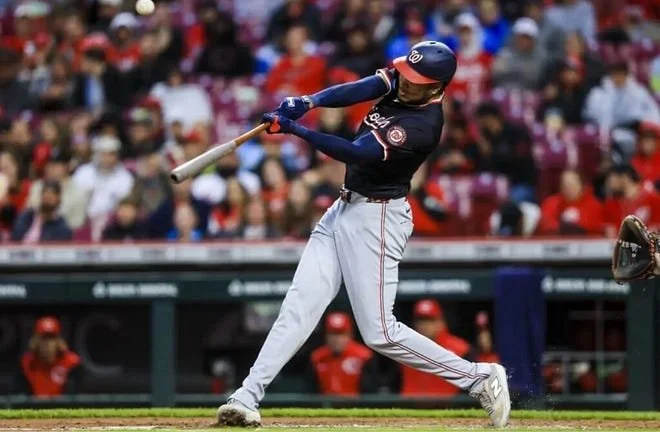
James Wood is a player I’ve watched develop for several years. He immediately was one of the most interesting prospects in the game for me when he was drafted. The 6’6”, 234-pound outfielder possesses exceptional athleticism for his size and stands out as one of the most promising young talents in baseball. At just 23 years old, the Maryland native, originally drafted by the Padres combines rare physical tools with a rapidly maturing approach. In my view, he represents an ideal building block for the Nationals as they transition toward sustained contention, with the potential to anchor the lineup alongside CJ Abrams and the rest of their young core.
Offensive Profile: Elite Power Paired with Growing Discipline
Wood has had a strong start to the 2026 season. and likely will improve.Through the initial stretch he has posted a .238/.387/.524 slash line with 12 home runs, 29 RBI, and 7 stolen bases. These numbers place him among the National League leaders in OPS, home runs, and on-base percentage. He is building on his 2025 performance. 256/.350/.475 with 31 home runs and 15 steals over 157 games. Wood shows a clear upward trajectory.
Statcast data shows the exceptional quality of his contact. He ranks in the 100th percentile with an average exit velocity exceeding 96 mph, along with a 60%+ hard-hit rate and a barrel rate above 27%. His expected wOBA sits at an elite .428, with xSLG near .611. An 18% walk rate (98th percentile) and continued improvements in chase rate and in-zone contact reflect a more disciplined hitter who can drive the ball to all fields with authority.
Comparisons come naturally. Wood’s compares as left-handed Aaron Judge in terms of raw power and impact at a similar age, or a powerful version of dynamic players like Corbin Carroll and Pete Crow-Armstrong. Historically, his frame and exit velocities bring to mind a healthy Giancarlo Stanton or the athletic slugging style of Dave Winfield. With a .260-.280 batting average, 30+ home runs, a high OBP, and 15–25 stolen bases each year, Wood profiles as a perennial MVP candidate and a true middle-of-the-order threat.
Defense and Overall Value
Originally playing center field. He is primarily playing left and right field these days, Wood has solid traditional fielding percentages (in the .986-.991 range). However, advanced metrics indicate he has room for continued growth. His Outs Above Average (OAA) has improved but remains negative (around -4 in 2026), with Defensive Runs Saved also reflecting below-average marks in limited outfield samples thus far. His range can be challenged in certain directions due to his large frame, though he possesses a strong arm (76th percentile) and above-average sprint speed.
He is not in the class of elite defenders like peak Mike Trout or Luis Robert Jr., but he compares favorably to power-oriented corner outfielders such as Aaron Judge or a more athletic Kyle Schwarber. With the ongoing defensive emphasis he has shown in 2026, he should reach average (or slightly below-average) play in a corner outfield spot. Given the quality of his offense, any defensive limitations are manageable and do not diminish his overall impact. His surprising baserunning adds another valuable layer.

Long-Term Outlook
At 23, Wood is already exhibiting the traits of a potential superstar. With further defensive improvement, he projects as a consistent 4–6+ WAR player capable of delivering 25–35 home runs per season while maintaining strong plate discipline and speed. As a local player with strong makeup and marketability, he possesses the intangibles to serve as the face of the franchise for years to come.
Extension Considerations: A Strategic Opportunity(Why they both should consider)
Wood remains under team control on a pre-arbitration contract (approximately $807K in 2026), with arbitration eligibility running through roughly 2030 and free agency following that season. A long term extension likely 8–10 years in the $120–200 million range, structured with options and escalators would keep him through his prime while providing him substantial early-career security. A deal like this would align with recent extensions for young stars like Jackson Merrill and Corbin Carroll, with potential to reach higher tiers if his production continues at this level.
For Wood, an extension offers wealth, the chance to remain near home(seems to be the rare player who thrives in this environment), and the opportunity to lead a promising young core without the uncertainty of future negotiations. For the Nationals, it delivers cost certainty through his peak years (ages 24–34), accelerates their contention timeline, and prevents the risk of losing a key piece from the Soto trade in free agency.
In summary, James Wood offers a blend of size, power, patience, and athleticism. While his defense remains a work in progress, his bat is already elite and game-changing. Extending him now would be a forward-thinking move to secure a potential perennial All-Star and MVP contender, the hometown talent capable of anchoring Washington’s lineup for the next decade.
