They called it Black Wall Street
They called it Black Wall Street
Ashes of Prosperity: A Reflection on the Tulsa Race Massacre of 1921

I sometimes wonder what it must have felt like to walk the streets of Greenwood in the spring of 1921 proud, self-made, and thriving in a place once called “Black Wall Street.” In the Greenwood District of Tulsa, Oklahoma, Black entrepreneurs had built something extraordinary during the tight grip of Jim Crow. Doctors, lawyers, barbers, grocers, and bankers created a bustling ecosystem of Black-owned businesses, homes, schools, and churches. It was a living rebuke to the lie that Black success depended on White. permission. Yet prosperity, as history too often reminds us, can be a dangerous thing when it stirs envy and fear.
The conditions that led to coming horror were a toxic mix of post-World War I tensions, rampant racial resentment, and economic jealousy. Tulsa was booming with oil money, but opportunities were strictly segregated. White residents, many of them recent arrivals or veterans, chafed at the sight of Black affluence in Greenwood while they navigated their own uncertainties. Lynchings and racial violence were not uncommon across the country during the “Red Summer” of 1919 and beyond. In Tulsa, rumors, sensationalist newspapers, and a culture that viewed Black achievement as a threat created a powder keg waiting for a spark.
That spark came on May 30, 1921. A 19-year-old Black shoe shiner named Dick Rowland was riding in an elevator with a 17-year-old white elevator operator, Sarah Page. She screamed; he was accused of assault (a charge later dismissed and since regarded as false or exaggerated). The Tulsa Tribune fanned flames with coverage and an editorial hinting that a lynching might be appropriate. By evening, a white mob gathered at the courthouse where Rowland was held. A group of armed Black men(many former US military), determined to prevent another lynching, arrived to offer protection. A confrontation erupted shots were fired, and a white man was killed. What began as a standoff rapidly spiraled into organized terror.
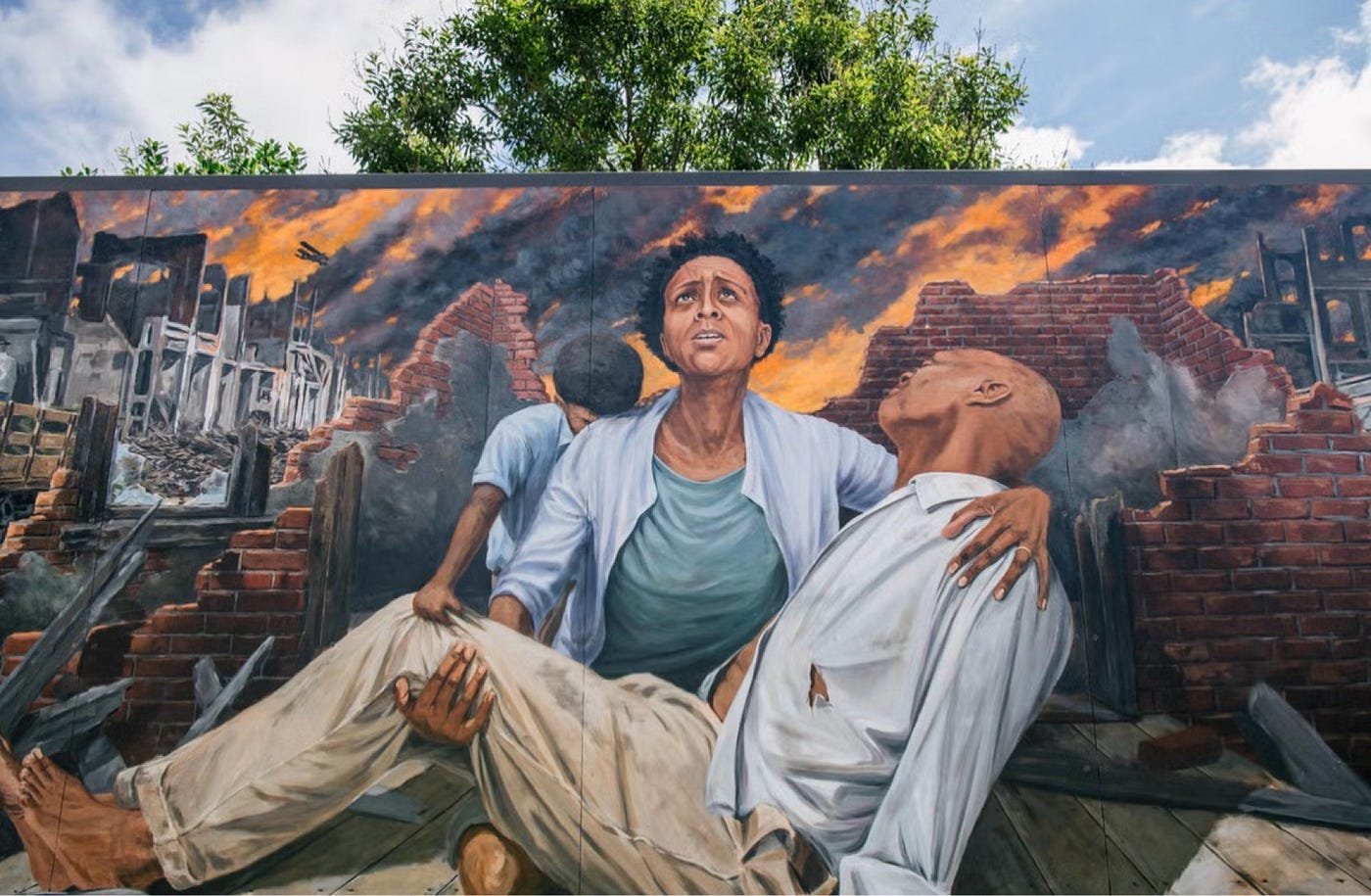
Over the next 18 hours or so, from May 31 into June 1, a white mob estimated in the thousands and often deputized or enabled by local authorities invaded Greenwood. They looted homes and businesses, set fires, and attacked residents. Eyewitness accounts and later investigations describe machine guns, arson, and even private airplanes dropping bombs. It was not mere “mob violence” but, as a 2025 Justice Department report described it, a coordinated, military-style assault. The Oklahoma National Guard was eventually called in by the governor. Rather than purely restoring order, many guardsmen participated in rounding up Black residents at gunpoint, disarming them, and detaining thousands (as many as 6,000) in internment camps, where some were forced into labor. Martial law was declared on June 1, finally stopping the worst of the violence.
The outcome was devastating. Between 75 and 300 Black residents were killed (exact numbers remain uncertain due to the cover-up). More than 35 square blocks roughly 1,200 homes and businesses were destroyed by fire. Property damage exceeded $2 million at the time (hundreds of millions in today’s dollars). Ten thousand people were left homeless. The heart of Black Wall Street was reduced to smoldering ashes.
Immediately afterwards, survivors faced further indignity. Many were held in camps for days. A grand jury largely blamed the Black community. No significant reparations or accountability followed for the perpetrators. The city and real estate interests even attempted to block rebuilding by changing zoning laws. Yet Greenwood residents showed remarkable resilience: many homes and businesses were rebuilt within a few years, though the community never fully regained its pre-1921 vibrancy.
Many who fled never returned, scattering to places like Kansas City, Chicago, or Topeka to start over. Some families carried the trauma silently for generations. Famous figures connected to the tragedy include historian John Hope Franklin, whose father survived the events, and jazz saxophonist Hal Singer (“Cornbread”), who escaped as a toddler. Survivors like Viola Fletcher (who lived past 110) and others later became powerful voices for remembrance and justice, testifying before Congress well into their later years.
Black Wall Street itself was a symbol of what was possible under adversity. Black doctors performing surgeries, lawyers practicing law, entrepreneurs building wealth without reliance on white patronage. Today, the Greenwood Rising Black Wall Street History Center serves as a powerful museum and educational space in the historic district. It honors the achievements before the massacre, documents the violence, and celebrates the community’s enduring spirit. Interactive exhibits, survivor testimonies, and a focus on resilience make it an important site of remembrance rather than just mourning. The only surviving original structure from that era, Vernon AME Church, still stands.
The massacre was buried in official silence for decades, a deliberate act that only compounded the original wound. Yet from those ashes, something stubborn and hopeful persists. As one reflection on resilience puts it, the story of Greenwood is ultimately about a people who “keep coming back and keep fighting.”
In the words of the survivors and their descendants, we hear echoes of endurance: “I have lived through the massacre every day,” Viola Fletcher once said yet she and others continued to demand truth and repair.

May we remember not only the horror, but the humanity and the quiet, unyielding strength that no fire could extinguish. The story of Tulsa’s Black Wall Street is a chapter of American history that wounds, but also inspires us to build better, remember honestly, and guard against the darkness that envy and fear can unleash.
For more information please visit this excellent visual story
https://www.theatlantic.com/sponsored/hbo-2019/the-massacre-of-black-wall-street/3217/
#Blackhistory #tulsamassacre #Blackwallstreet