Roki Sasaki’s Transition to MLB Stardom: Promise, Struggles, and the Path Forward.
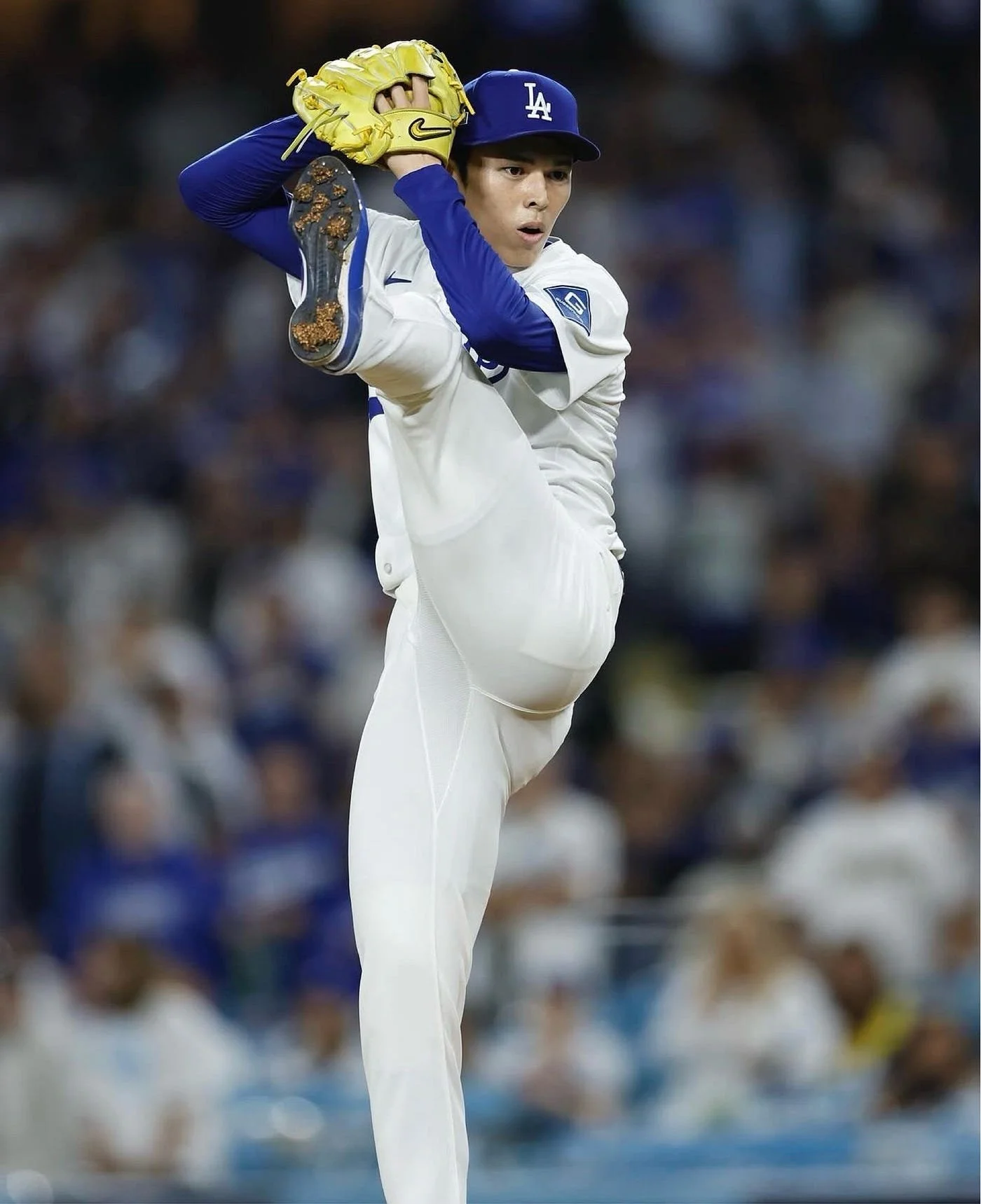
Roki Sasaki’s Transition to MLB Stardom: Promise, Struggles, and the Path Forward.

Roki Sasaki, the Japanese right-handed pitcher nicknamed the “The Monster of the Reiwa Era,” (meaning the Japanese considered him a generational pitcher)emerged as one of the most hyped International pitching prospects of recent memory. Born in 2001, he exploded onto the scene with the Chiba Lotte Marines in Nippon Professional Baseball (NPB), with historic performances there including a perfect game in 2022(at 20 years old)and show e consistently elite strikeout rates. His combination of mid-to-upper-90s (and occasionally 100’s) velocity, a devastating splitter, and command made him nearly untouchable in Japan, where he had sub 2.50 ERAs and strikeout rates often that exceeded between 10–13 per nine innings in his peak seasons.
In January 2025, Sasaki signed with the Los Angeles Dodgers under international amateur rules (due to his age being 23, under the cutoff of 25). His signing bonus of 6.5 Million Dollars would have put him at the back end of the top 10 players in the first round. Essentially giving the Dodgers another high first round selection before the draft year started.
The Dodgers, coming off a World Series win and already with former NPB stars Shohei Ohtani and Yoshinobu Yamamoto, viewed him as a high-upside addition to their rotation. Expectations were sky high for the then 23-year-old. His 2025 MLB debut proved challenging: he dealt with a shoulder impingement, inconsistent command as a starter, and ultimately found greater success in a relief role during the postseason.
As of late April 2026, Sasaki’s second MLB season has been a struggle in the starting rotation. Through 22.2 innings across five starts, he holds a 6.35 ERA, 1.81 WHIP, and has allowed 28 hits, 16 earned runs, 7 home runs, and 13 walks while striking out 22. His K/9 sits around 8.7, which is solid but not dominant by his standards or an elite MLB starter . These numbers reflect a pitcher with potentially dominant stuff who has yet to harness it consistently over multiple innings against major-league lineups.
Effectiveness in Japan vs. Struggles in MLB
In NPB, Sasaki dominated with a fairly simple but devastating two-pitch mix (primarily fastball and splitter) against hitters who swung more aggressively and in a league with different offensive approaches, ball specifications, and strike zones. His elite velocity and splitter’s late dive generated swings-and-misses and weak contact, supported by strong command that limited deep counts.
In MLB, the challenges are multifaceted. What makes ML hitters special is that they typically. can hit high velocity, especially if you can’t change speeds effectively. Hitters are more disciplined, work deeper counts, and punish elevated or mislocated fastballs. Sasaki has struggled with mechanical consistency and repeating his delivery, leading to command issues particularly with fastball location and overall strike throwing. This has resulted in higher walk rates (around 5.2 BB/9 early in 2026 which is considered below average to mediocre), elevated pitch counts, and fatigue that compromises his stuff later in outings. The transition to a five-day rotation (versus shorter or more flexible NPB schedules) has also tested his durability and stamina.
2026 Pitch Repertoire and Command
In 2026, Sasaki primarily relies on a three-pitch mix: four-seam fastball (41.5%, averaging 97.1 mph), split-finger fastball/splitter (35%, 86.8 mph), and slider (23.5%, 86 mph). He has worked on refining the slider (sometimes described with as gyro) as a needed third pitch to handle both sides of the plate and provide a pitch that “goes left.”
Command remains his primary hurdle. The fastball, while still high velocity, lacks precise location, he often misses arm-side or elevated, where it gets barreled. The splitter has maintained strong swing and miss (high-30s% whiff rate) but can be vulnerable when left up. The slider has shown promise with depth and swing-and-miss but inconsistent execution. Overall location metrics aren’t good. He is consistently working with a lot of traffic on the bases.
Pitches getting hit hard: The four-seamer has been punished (.395 BA, high SLG, elevated exit velocities around 90+ mph on contact), especially when elevated or over the heart of the plate. Home runs have come at a high rate (2.78 HR/9).
2026 Splits (vs. LHB / RHB)
Early 2026 data shows he hasn’t been good against either side , with left-handed hitters potentially seeing the ball better and capitalizing on fastball mistakes. He doesn’t have a consistent sweeping glove side pitch to keep right-handed hitters honest. Opponent batting average sits around .304 overall, with lefties and righties both posting strong OPS figures in the .940–1.05 range so far. He has allowed multiple home runs to each side.
Advanced Metrics Context
- SIERA (Skill-Interactive ERA): Sasaki’s current SIERA is likely in the mid-4s to low-5s range based on his K-BB profile and batted-ball data (projections point toward 4.5–5.5 territory for this season if this continues). SIERA emphasizes strikeouts, walks, and ground-ball rates while adjusting for the difficulty of inducing weak contact. A number in the low-to-mid 4s would suggest average-to-below-average starter performance with room for improvement if command tightens; sub-4.00 is elite, while higher than 4.50+ indicates below-average sustainability for a rotation piece, that is where he is currently residing
- K-BB%: Around 8–9% early (20% K% minus 12% BB%), below average for a high-upside starter (elite starters often exceed 15–20%).
- BABIP: Likely elevated in the .320-.330 range (overall opponent .304 AVG with batted balls in play). League-average BABIP is around .290-.300; above .320 often signals bad luck or poor defense/luck on contact, while sub-.280 is elite. Not great, not bad but tells you it’s the lack of command that kills him more than the bats.
What’s His Path to Effectiveness?
Beyond the obvious throwing more strikes. Sasaki’s development should focus on refining pitch usage and sequencing to maximize his strengths. This is the classic case of not being able to command the fastball well enough to get ahead so that he can use the secondary pitches. He also doesn’t command his secondary pitches well enough to use at anytime in the count.
Increasing usage of the splitter in two-strike counts and locating the slider(gyro) more effectively against opposite-handed hitters could help.

Developing better fastball command (perhaps through mechanical tweaks to shorten up so that he can repeat delivery) is essential to set up the offspeed pitches.
A hybrid role or shorter outings (4–5 innings max high-leverage starts) could allow him to repeat his postseason bullpen success while building stamina. Long-term, consistent mechanics and a reliable third pitch will allow him to handle lineups multiple times. The Dodgers’ player development has a strong track record; with patience, Sasaki’s superior arm talent should allow for success as a mid-rotation starter with stuff that should play better than this.
Sasaki’s performance so far shows the difficulty of the NPB-to-MLB transition. At 24, with plus stuff and plenty of organizational support, his struggles are developmental. Continued focus on command, sequencing, and load management should unlock the pitcher who was dominant in Japan. Dodgers fans and baseball enthusiasts alike have reason for measured optimism. Though I do have concerns about how this is affecting him mentally, especially his confidence. A trip down to AAA(which his recent comments suggest he is open to) to build him back up could be necessary.
The talent is clearly here but it will require time and frankly mental toughness to reach it.
#MLB
#Dodgers
#Baseball